For Caring Parents Who Want Their Child To Succeed—Not Just “Get By”
Finding Success In Key Stage 3 Science
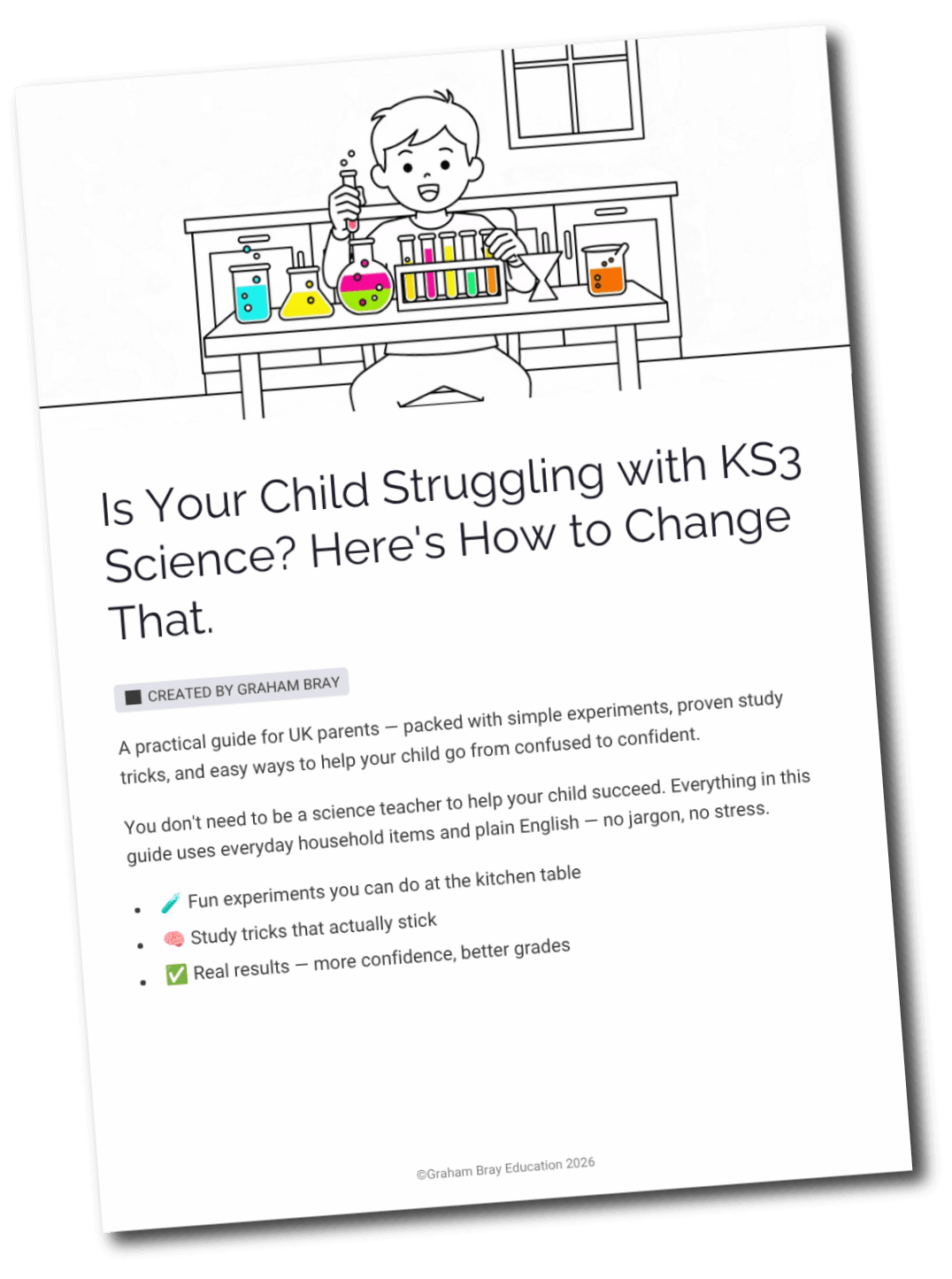
Discover the essential knowledge, study habits, and exam-ready strategies that help students thrive in Key Stage 3 Science.
This free guide shows you how to build confidence, strength understanding, and create the foundations for future success in GCSE Science
Master the core scientific concepts
that every Key Stage 3 student needs to know.
🧪 3 Hands-On Experiments done at your kitchen table — no specialist equipment needed
Avoid the most common mistakes
that hold students back in Biology, Chemistry, and Physics.
🧠 Study techniques used by top-performing students that actually make knowledge stick
Develop effective revision habits
that actually improve understanding—not just memorisation.
✅ Real Results. More confidence, better grades, and a child who enjoys science again
Sound Familiar? You're Not Alone.
Thousands of parents across the UK watch their child come home from school, sit down with their science homework… and completely switch off. It's not because they're not clever — it's because science is often taught in a way that doesn't click for every child.
Here's what we hear from parents every week:
My child just doesn't get it
No matter how many times we go over it
They used to love science
Now they dread it
I don't know enough science myself
To help them at home
None of this means your child is bad at science. It means they haven't found the right approach yet.
That's exactly what this free guide is for.
The KS3 Topics That Trip Most Students Up

Forces

Energy

Cells

Chemical Reactions
Electricity
The good news?
Every single one of these topics becomes much easier with the right explanation and a bit of hands-on fun.
Hello, I'm Graham Bray
As a teacher with over 33 years’ experience in the classroom I am passionate about education which is why I have developed these resources to help students really understand the key ideas in science, and so equip them for examination success.
These resources have already helped hundreds of students achieve success and I look forward to supporting you on your learning journey.
Working with families just like yours — parents who want to help but aren't sure how.
You don't need a science degree. Everything in this guide is written for parents, not teachers.
Students who apply these techniques consistently see real improvements in confidence and grades.

I created this free guide because every child deserves to feel capable in science — and every parent deserves to feel able to help. — Graham Bray
Here's What You'll Get in This Free Guide
This isn't a textbook. No long essays, no complicated diagrams, and absolutely no jargon. Just simple, proven ways to make KS3 science feel less like a chore — and more like something your child actually wants to do.
🧪 3 Kitchen Table
Experiments
Hands-on activities covering the trickiest KS3 topics — using things you already have at home. When your child can see science happen in front of them, it stops being abstract and starts making sense.
🧠 2 Proven Study Techniques
The same methods used by top-performing students — simple to follow, and backed by science. These aren't revision gimmicks. They're evidence-based techniques that help knowledge actually stick.
💬Plain-English Explanations
Every topic broken down so that both you and your child can understand it — no science degree required. If you can read this page, you can use this guide.
What's Possible When Science Finally Clicks
We've seen it happen hundreds of times. A child who dreaded science starts doing experiments at home for fun.
A student predicted a 3 walks into their exam confident — and comes out with a 7.
3X
Better Retention
Students who use hands-on learning retain information 3x longer than those who only read
78%
Improved Grades
of students who struggled with science improved their grades after switching to active learning methods
10 mins
per day
That's all it takes using these techniques to see a real difference within weeks
Here's What Parents Tell Us:

My daughter went from hating science to asking to do experiments at the weekend. I couldn't believe the change.
Sarah
Mum of a Year 8 student

His confidence has completely transformed. He actually put his hand up in science class last week — first time ever.
James
Dad of a Year 9 student

I was worried I wouldn't be able to help him at home because I'm not sciency myself. But the experiments were so simple, we did them together.
Emma
Mum of a Year 7 student
Get Your Free Guide Now
Enter your email below and we'll send it straight to your inbox. No spam, no strings — just a genuinely useful resource for your family.
Your child is not bad at science. They just haven't found their way in yet.
And you're already one step closer — because you're here.
© 2026 Graham Bray Education